
Ribospin™ II RNA Purification Kit (GeneAll): Fast, Spin-Column RNA Extraction from Cells and Tissues
Introduction
RNA is the molecule that tells researchers what a cell is doing right now. Gene expression studies, RT-qPCR, RNA sequencing, and transcriptome profiling all depend on it. But RNA is fragile. Ribonucleases (RNases) are found everywhere and degrade it within minutes, so a good extraction method has to disrupt the sample, protect the RNA, and deliver a clean product quickly.
The Ribospin™ II kit from GeneAll Biotechnology is a spin-column RNA purification kit built for this task. Its handbook (Ver. 1.1) describes a simple workflow for cultured cells and tissues, with a preparation time of about 30 minutes or more. This article covers what the kit is, what is in the box, which samples and amounts it accepts, and how to store and handle it.
What Is Ribospin™ II?
Ribospin™ II is a silica-membrane spin-column kit for total RNA purification. According to the specification table, its format type is “Spin.” The usual principle of this approach is:
- Lysis and homogenization: the sample is disrupted in a lysis buffer (here, Buffer RAL) that inactivates RNases.
- Binding: after ethanol is added, RNA binds to the silica membrane in the column.
- DNase treatment: DNase I removes contaminating genomic DNA.
- Washing: wash buffers remove proteins, salts, and other impurities.
- Elution: pure RNA is released in nuclease-free water.
The kit contains a DNase I component (240 Kunitz units, per the vial label), which indicates that DNA removal is part of the workflow. For exact steps, volumes, and incubation times, follow the handbook.
What Is in the Box?
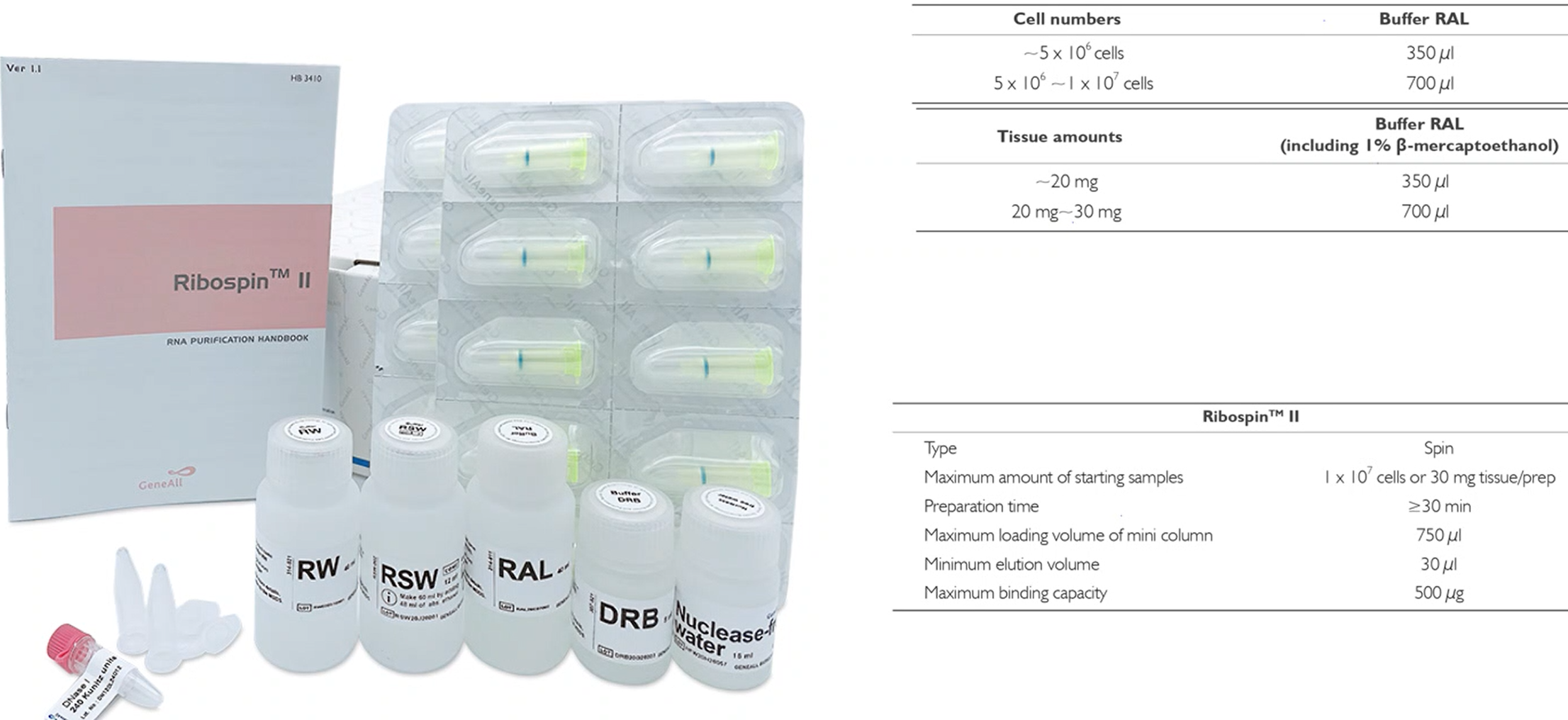
The photo shows the handbook, spin columns in blister packs, collection tubes, reagent bottles, and a small vial of enzyme.
| Component | Notes from the image |
|---|---|
| Handbook | “Ribospin™ II RNA Purification Handbook,” Ver. 1.1 |
| Spin columns | Mini columns packed in protective blister trays |
| Collection tubes | Small clear tubes |
| Buffer RAL | Lysis buffer (bottle labeled RAL) |
| Buffer RW | Wash buffer (bottle labeled RW) |
| Buffer RSW | Wash buffer concentrate; the label indicates adding absolute ethanol to reach the final volume |
| Buffer DRB | Buffer used with the DNase step |
| DNase I | Vial with a pink cap, 240 Kunitz units |
| Nuclease-free water | 15 mL, for elution |
Buffer RSW is supplied as a concentrate. Before first use, add absolute ethanol as indicated on the label. Note the date on the bottle once this is done, and keep it tightly closed.
Sample Amounts and Buffer Volumes
The tables shown with the product give the lysis buffer volume to use depending on the starting material.
Cultured Cells
| Cell number | Buffer RAL |
|---|---|
| Up to ~5 × 10⁶ cells | 350 µL |
| 5 × 10⁶ to 1 × 10⁷ cells | 700 µL |
Tissue
| Tissue amount | Buffer RAL (including 1% β-mercaptoethanol) |
|---|---|
| Up to ~20 mg | 350 µL |
| 20 mg to 30 mg | 700 µL |
Note that for tissue, the lysis buffer is supplemented with 1% β-mercaptoethanol. This reducing agent helps inactivate RNases, which is especially important in tissues rich in these enzymes.
Technical Specifications
| Parameter | Ribospin™ II |
|---|---|
| Type | Spin |
| Maximum starting sample | 1 × 10⁷ cells or 30 mg tissue per prep |
| Preparation time | ≥ 30 minutes |
| Maximum loading volume of mini column | 750 µL |
| Minimum elution volume | 30 µL |
| Maximum binding capacity | 500 µg |
A few points are worth noting:
- A minimum elution volume of 30 µL allows RNA to be recovered in a concentrated form, which is useful for downstream reactions with limited input volumes.
- A binding capacity of up to 500 µg shows the column can handle RNA-rich samples without becoming saturated.
- A 750 µL loading volume means larger lysate volumes are loaded in more than one step.
Key Advantages
1. Simple spin-column workflow. Standard centrifugation, no phenol or chloroform.
2. Fast processing. The specification lists a preparation time of 30 minutes or more.
3. Clear sample guidelines. The tables tell the user exactly how much lysis buffer to use for each cell number or tissue amount.
4. DNase I included. The kit contains a DNase I component to help remove genomic DNA contamination.
5. Concentrated wash buffer. Less bulk to store; add ethanol when ready.
6. Complete kit. Columns, tubes, buffers, DNase I, and nuclease-free water are provided.
7. Handbook included. The procedure is documented in the accompanying handbook.
Applications
Gene Expression Analysis
RNA from cells and tissues is the standard input for RT-qPCR and other expression assays.
RNA Sequencing
High-quality total RNA is the starting material for library preparation. Always check that the integrity and yield fit your sequencing method.
Cell Biology and Drug Response Studies
Researchers extract RNA from cultured cells to study how treatments, knockdowns, or stimuli change gene expression.
Tissue Profiling
With up to 30 mg of tissue per prep, the kit can be used for animal tissues in physiology, toxicology, and disease model studies.
Reverse Transcription and cDNA Synthesis
Purified RNA is routinely converted to cDNA for cloning and amplification.
Method Development and Teaching
A standardized kit helps laboratories keep extraction consistent across users and experiments.
General Workflow
The exact protocol is in the handbook. In general:
- Prepare reagents: add absolute ethanol to RSW, and reconstitute DNase I as directed.
- Prepare lysis buffer: for tissue, add β-mercaptoethanol to Buffer RAL to 1%.
- Lyse and homogenize the cells or tissue using the volume indicated in the tables.
- Adjust binding conditions with ethanol and load the lysate onto the column (up to 750 µL at a time).
- Centrifuge to bind RNA.
- Treat with DNase I on the column, then wash with the wash buffers.
- Dry the membrane.
- Elute with nuclease-free water (minimum 30 µL).
- Quantify and check quality by spectrophotometry or an RNA integrity analysis.
Storage and Handling
- Store the buffers at room temperature, as shown on the labels.
- Store DNase I as stated on its label and in the handbook.
- Add ethanol to RSW before first use, and keep the bottle closed.
- Use β-mercaptoethanol in a fume hood or well-ventilated area, since it is hazardous and has a strong odor.
- Do not mix lysis buffers with bleach or strong oxidizers.
- Work RNase-free: wear gloves, use nuclease-free tubes and tips, and clean surfaces.
- Process or freeze samples quickly, since RNA degrades fast in untreated samples.
- Record lot numbers for traceability.
- Follow your institution’s safety and waste regulations.
Why Use a Kit?
Manual methods based on phenol-guanidine reagents can give good yields, but they take more handling, involve hazardous organic solvents, and show more variation between users. A spin-column kit offers:
- Reproducibility across users and batches
- Safer handling, without phenol and chloroform
- Time savings and an easier workflow
- Ready-matched reagents
About GeneAll Biotechnology
GeneAll Biotechnology is a manufacturer of nucleic acid purification kits and related molecular biology products. The GeneAll branding appears on the handbook and the bottle labels. Ribospin™ II belongs to its RNA purification range, alongside its Exgene™ line for genomic DNA.
Frequently Asked Questions
What samples can I use?
Cultured cells (up to 1 × 10⁷) and tissue (up to 30 mg) per preparation.
How long does a preparation take?
The specification lists 30 minutes or more.
What is the minimum elution volume?
30 µL.
What is the maximum RNA binding capacity?
Up to 500 µg per column.
Does the kit remove genomic DNA?
It includes DNase I, which is intended for this purpose. Follow the handbook for the procedure.
Do I need β-mercaptoethanol?
For tissue, the table specifies Buffer RAL including 1% β-mercaptoethanol. It is not included in the kit, so you need to supply it.
Do I need to add ethanol?
Yes, to Buffer RSW before first use, and also during the binding step, as described in the handbook.
Conclusion
The Ribospin™ II kit from GeneAll offers a clear, efficient way to purify total RNA from cultured cells and tissues. With a fast spin-column workflow, included DNase I, clear sample-to-buffer guidelines, and a binding capacity of up to 500 µg, it suits gene expression studies, RNA sequencing preparation, and routine molecular biology work.