
Rapid 3'-End Labeling and Purification Kit (YD Biolabs): On-Demand Oligonucleotide Labeling with Built-In Purification
Introduction
Labeled oligonucleotides are essential tools in molecular biology, used as probes, primers, capture molecules, and imaging tags. But labeling is only half of the job. After the reaction, the labeled product has to be separated from unreacted dye and reagents, otherwise background signal can ruin the downstream assay.
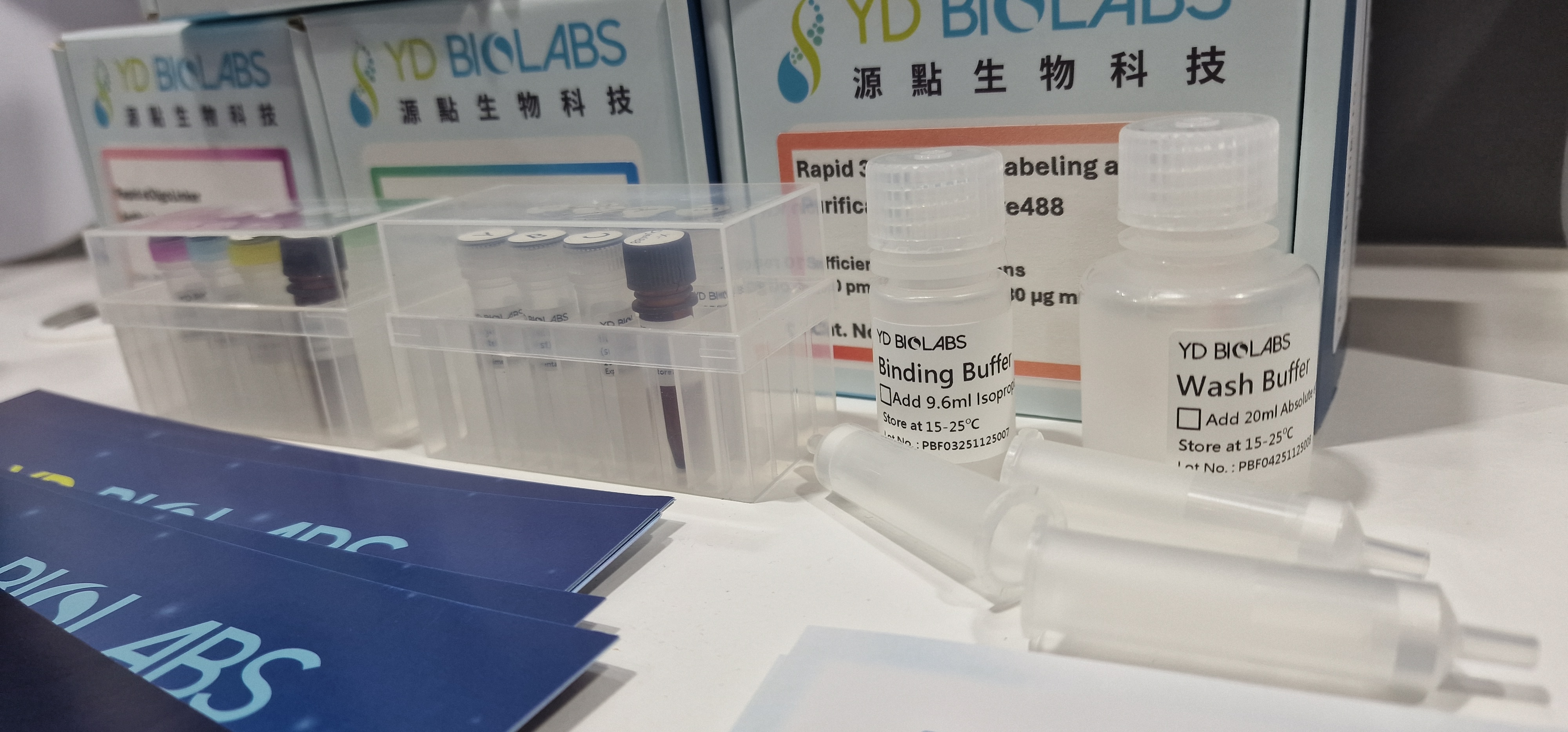
YD Biolabs addresses both steps with a kit that combines labeling and purification in one box. The packaging in the photo reads “Rapid 3'… labeling a[nd] Purification… [Alexa Fluor?] 488,” which points to a 3'-end labeling kit with a green fluorescent dye (the label is partly hidden, so the exact dye name must be confirmed). This article covers what the kit includes, how the purification components work, and where it can be used.
What Is 3'-End Labeling?
Labeling the 3' end of an oligonucleotide means attaching a functional group, such as a fluorescent dye, to the last nucleotide of the strand. It complements 5'-end labeling, which attaches the label at the opposite end. Having both options lets researchers choose the position that best preserves the function of their probe.
A 3'-end label is useful because:
- It leaves the 5' end free for other modifications or enzymatic reactions.
- It can help protect a probe from certain 3' exonuclease activities.
- It lets researchers build dual-labeled designs together with a 5' label.
YD Biolabs presents itself as a partner in enzyme-driven nucleic acid labeling, so this kit follows the same on-demand approach as its 5'-end ssDNA labeling kits.
What Is in the Box?
The photo shows several YD Biolabs boxes, two plastic racks of tubes, bottles, and purification columns.
| Component | Notes from the image |
|---|---|
| Kit box | “Rapid 3'… Labeling and Purification,” with a 488 dye designation (partly hidden) |
| Reagent tubes in racks | Several small tubes with colored caps, including a dark brown tube, typically used for light-sensitive components |
| Binding Buffer | Label: add 9.6 mL isopropanol; store at 15–25 °C |
| Wash Buffer | Label: add 20 mL absolute ethanol; store at 15–25 °C |
| Purification columns | Clear plastic spin columns, shown on the table |
| Lot numbers | Printed on each bottle for traceability |
Both buffers are supplied as concentrates that the user completes with alcohol before first use. This is a common approach: it keeps the kit compact and avoids shipping flammable liquids. Tick the box on each label once the alcohol is added.
How Does the Purification Work?
The presence of a binding buffer, a wash buffer, and columns indicates a column-based purification of the labeled oligonucleotide. The general principle is:
- Binding: the reaction mixture is combined with Binding Buffer (completed with isopropanol), and the labeled oligonucleotide binds to the column matrix.
- Washing: Wash Buffer (completed with ethanol) removes free dye, enzymes, salts, and other reaction components.
- Elution: the purified labeled oligo is released in a small volume of elution solution.
This removes unreacted dye, which is the main source of background in fluorescence assays. For exact volumes, centrifugation steps, and elution conditions, follow the kit manual.
Key Advantages
1. Labeling and purification in one kit. There is no need to source separate cleanup reagents.
2. On-demand labeling. Label an oligo you already have, instead of waiting for a custom synthesis order.
3. Complete package. Reagent tubes, buffers, and columns come together.
4. Clear instructions on the labels. Each buffer states the alcohol to add and the storage temperature.
5. Room-temperature buffers. Binding and wash buffers are stored at 15–25 °C.
6. Traceability. Lot numbers are printed on the components.
Applications
Fluorescent Probes
Dye-labeled oligonucleotides are used in hybridization assays, fluorescence microscopy, and in situ detection.
Binding and Interaction Studies
Labeled DNA is a standard tool for gel-shift assays, fluorescence polarization, and FRET-based studies.
Dual-Labeled Probe Design
A 3'-end label can be combined with a 5'-end label, for example in probes that need two different functional groups.
Diagnostics and Biosensor Development
Labeled oligos serve as detection and capture elements in assay development.
DNA Nanotechnology
Fluorescently labeled strands are used to track assembly and structure.
Teaching and Method Development
An all-in-one kit helps students and new users learn labeling and cleanup in a controlled workflow.
General Workflow
The exact protocol is in the manual. In general:
- Prepare the buffers: add isopropanol to the Binding Buffer and absolute ethanol to the Wash Buffer.
- Set up the labeling reaction with your oligonucleotide and the kit reagents.
- Incubate for the specified time, protecting light-sensitive components.
- Bind the reaction product to the column using the Binding Buffer.
- Wash to remove free dye and reagents.
- Elute the labeled oligonucleotide.
- Quantify and verify the product, for example by spectrophotometry or gel analysis.
- Store the labeled oligo protected from light.
Storage and Handling
- Store the Binding Buffer and Wash Buffer at 15–25 °C, as printed on their labels.
- Add the alcohol before first use (9.6 mL isopropanol and 20 mL absolute ethanol, per the labels), and keep the bottles tightly closed.
- Store the reagent tubes as stated on their labels and in the manual. Other YD Biolabs labeling components are stored at −20 °C, so confirm this for the kit.
- Protect fluorescent dyes from light, especially the brown tube.
- Use nuclease-free consumables and wear gloves.
- Handle isopropanol and ethanol away from flames and in a ventilated area.
- Record the lot numbers printed on each component.
About YD Biolabs
YD Biolabs (源點生物科技) is a biotechnology company that focuses on enzyme-driven nucleic acid labeling. Its materials emphasize on-demand oligonucleotide end-labeling, and its range includes kits for different labels and for both ends of the oligonucleotide, along with purification components.
Frequently Asked Questions
What does this kit label?
The packaging indicates a 3'-end labeling and purification kit with a 488 dye. Confirm the exact dye and target (DNA, RNA) in the manual.
Does it include purification?
Yes. The kit includes Binding Buffer, Wash Buffer, and columns.
Do I need to add anything to the buffers?
Yes. Add 9.6 mL isopropanol to the Binding Buffer and 20 mL absolute ethanol to the Wash Buffer before use, as printed on the labels.
How should I store the buffers?
At 15–25 °C.
How many reactions are in the kit?
The photo does not show this. Check the box or the product page.
Is there a 5'-end version?
YD Biolabs also offers the Rapid 5'-End ssDNA Labeling Kit, available with several labels.
Conclusion
The YD Biolabs Rapid 3'-End Labeling and Purification Kit gives researchers a practical, all-in-one way to label an oligonucleotide with a fluorescent dye and clean it up in the same workflow. With ready-to-complete buffers, purification columns, and clear labeling, it supports probe preparation, assay development, and nucleic acid research.